Freezer Repair
How to Stop a Sub-Zero Freezer From Humming
Quiet a humming freezer by fixing what makes the hum louder: a dusty condenser, frost on the fan, a door not sealing or a panel that vibrates.
Words by
Dean Halvorsen
- Role
- Refrigeration technician — sealed systems and airflow
- In the trade
- 19 years
- Holds
- EPA 608 certified
You cannot make a freezer silent, and you should not try: the low hum is the compressor moving refrigerant, and it stops by itself once the cabinet reaches temperature. What you can stop is the extra noise piled on top. Vacuum a dusty condenser, melt frost off the fan, shut a door that is not quite sealing and make sure nothing touches the cabinet, and most hums sink back into the background. A sound that turns to grinding, buzzes without any cooling, or never pauses is a fault rather than something to live with.
Normal sounds and fault sounds, side by side
| Sound | What it usually is | Your move |
|---|---|---|
| Low, even hum that starts and stops | Compressor cycling | Nothing |
| Soft rush of air | Fans moving air | Nothing |
| Short buzz, then trickling water | Ice maker valve filling | Nothing |
| Sizzle, hiss or pop | Defrost cycle at work | Nothing |
| Ticking that stops with the door open | Frost on the evaporator fan | Defrost, then watch |
| Rattle down at floor level | Condenser fan, loose grille or debris | Clean and check |
| Hum, click, silence, repeating | Compressor failing to start | Call for service |
Five checks before you pick up the phone
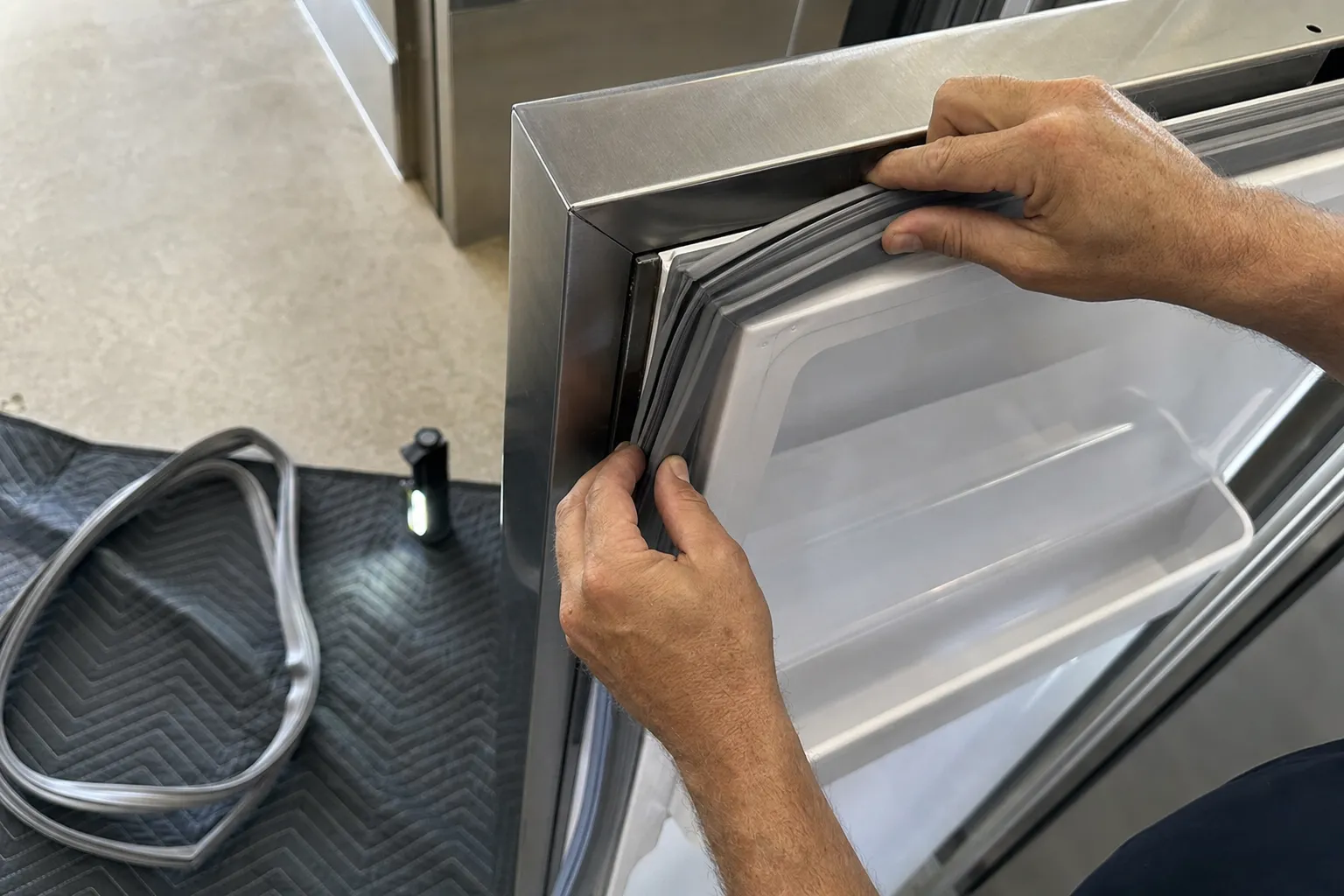
- Doors and drawers. One left slightly ajar keeps the compressor going nonstop. Push it shut and listen an hour later.
- Airflow inside. Packages jammed against the rear wall block the vents, so the system runs longer.
- The condenser. The coil hides behind the top grille, which flips up, on a Classic (CL), and behind a two-screw kickplate on a Designer (DET, DEC). Switch off at the control panel, wear gloves, and brush-vacuum along the fins.
- The setpoint. These freezers come set at 0°F (-18°C), adjustable one degree at a time; if someone pushed it much colder, bring it back.
- Loose trim. A grille screw that has backed out can buzz along with the compressor.
Noise that travels through an older house
Much of the housing in North Tacoma and the Proctor District is decades old and framed in wood, and a built-in sits tight inside cabinetry. Both details matter. Wood joists and hollow cabinet boxes carry vibration, so a perfectly ordinary compressor hum can sound like it fills the kitchen. Put your ear near the grille, then near the side panels. If the drone is loudest where the unit meets the cabinets rather than at the machinery, the freezer may have settled out of level or be touching a panel, and a technician can reset the leveling legs.
Frost on the fan: the hum that grows
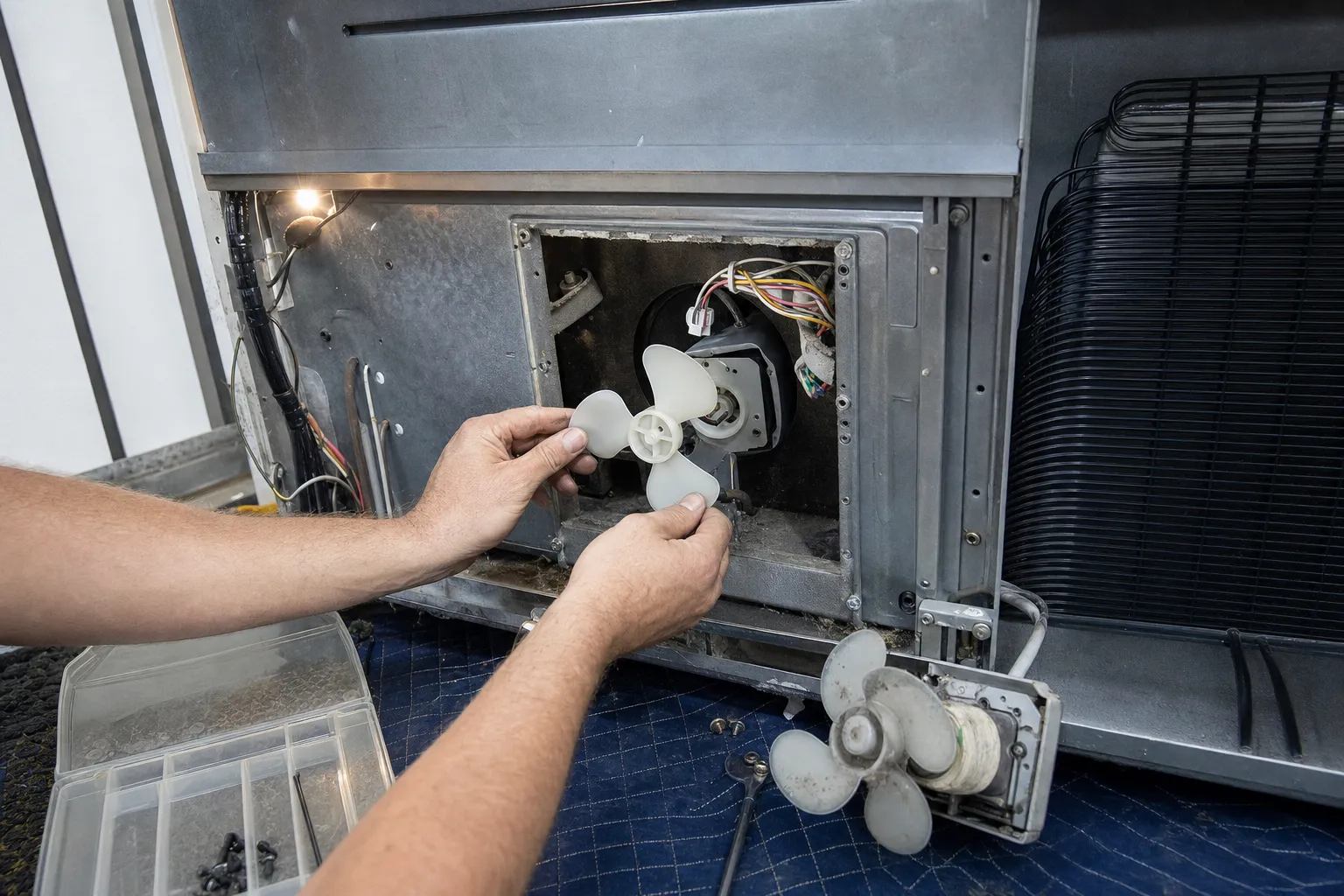
The evaporator fan lives behind the freezer’s back panel and draws air across the cold coil. When frost builds around it, the blades begin to scrape, and a soft rush becomes a rhythmic tick or a raspy whir that worsens over days. Sub-Zero’s guidance for melting heavy ice depends on the line. Classic (CL) and Designer (DET, DEC) owners are told to power the freezer down and play a hair dryer over the ice on its lowest heat, never holding it still. For PRO Series freezers the advice flips: a handheld steamer, and no hair dryer at all. If the frost is back within weeks, the defrost system is falling short, and our walk-through on reading the defrost circuit explains what a technician tests.
The buzz that comes from the ice maker
A buzz of a few seconds followed by running water is the inlet valve opening to refill the ice mold, and it is normal. A buzz that repeats with no water arriving means the valve is straining against a closed supply, a clogged filter or a frozen fill tube. If the ice maker is switched on while the water line is shut off, perhaps after a kitchen remodel, turn the ice maker off until the line is reconnected. One more sound catches owners out. Max ice, offered on Classic (CL), Designer (DET, DEC) and PRO units, pushes output as much as 30% higher across 24 hours, and some parts may spin faster and sound different until it ends.
A hum that never stops, or one that clicks off
A compressor that runs for hours without resting is fighting something: a dusty condenser, a flattened door gasket, a fan that has slowed, or a refrigerant problem in the sealed system. On units that display codes, such as the 648PRO, EC40 with Service flashing flags exactly this pattern: too much freezer compressor run, a door ajar, or a sealed system, fan or temperature sensor fault. The opposite pattern is worse news. A hum lasting a few seconds, a click, then silence, repeated every few minutes, is a compressor trying to start and being cut off. The freezer warms while that goes on, so move the food to a cooler and call.
What the display may be telling you
Classic (BI) models report fan trouble in the 35 family of codes, and 35 F 33 or 35 F 34 both point to the freezer evaporator fan. Sub-Zero suggests cutting power at the breaker, waiting 30 seconds, switching it back on, and booking service should the code reappear. If a chime rather than a hum is keeping you up, press and hold ALARM and POWER together and release both in under 5 seconds. That hides the indicator for 24 hours but leaves the fault in place, so use the quiet to arrange a visit. EC07 and EC08 mean erratic or failed freezer temperature readings with no owner fix; write down the code and displayed temperatures first.
When the noise means booking a visit
Get a technician out when the freezer is warming, when the sound is grinding or metallic, when a code keeps returning after a breaker reset, or when the compressor still runs nonstop a day after you cleaned the condenser. A visit costs $89 and pays for the trip plus the complete diagnosis; approve the repair and that $89 is taken off its price. We work across North Tacoma, Northeast Tacoma, the Stadium District and the Proctor District. Read more about our freezer repair service, or call (206) 472-1140 and describe the sound you are hearing.
Common follow-ups
Why is my freezer humming louder at night?
Usually the freezer is no louder at night; the house around it has simply gone quiet. The compressor cycles around the clock, and once traffic, voices and the dishwasher fall silent you notice each start. Worry only if the hum never pauses for hours, turns harsher week by week, or the ice cream is softer by morning.
Why does the noise stop when I open the freezer door?
That points to the evaporator fan, because on many freezers the door switch pauses the fan while the door is open. A whir or tick that vanishes when you open up and returns once the door shuts usually means frost is brushing the blades or the motor bearing is wearing.
Can I switch the freezer off overnight to get some quiet?
No, that trades a noise for spoiled food. Sub-Zero says an empty unit typically takes 3 hours to climb above 20°F in the freezer and 45°F on the refrigerator side with no power, so a whole night off is far too long. Lower the noise at its source instead.
Is a humming freezer about to break down?
A low, even hum that starts and stops is a healthy compressor, not a dying one. The warning signs sound different: a hum of a few seconds that ends in a click and repeats every few minutes, a grinding or rattling note, or a compressor that never rests while the freezer slowly warms. Those deserve a technician soon.
What does a noise diagnosis cost in Tacoma?
We charge $89 to come out, and that sum buys the whole diagnosis; say yes to the repair and the $89 is subtracted from what it costs. Frost or fan trouble is usually a modest fix, sealed-system work is the costly end, and the firm quote comes after diagnosis.